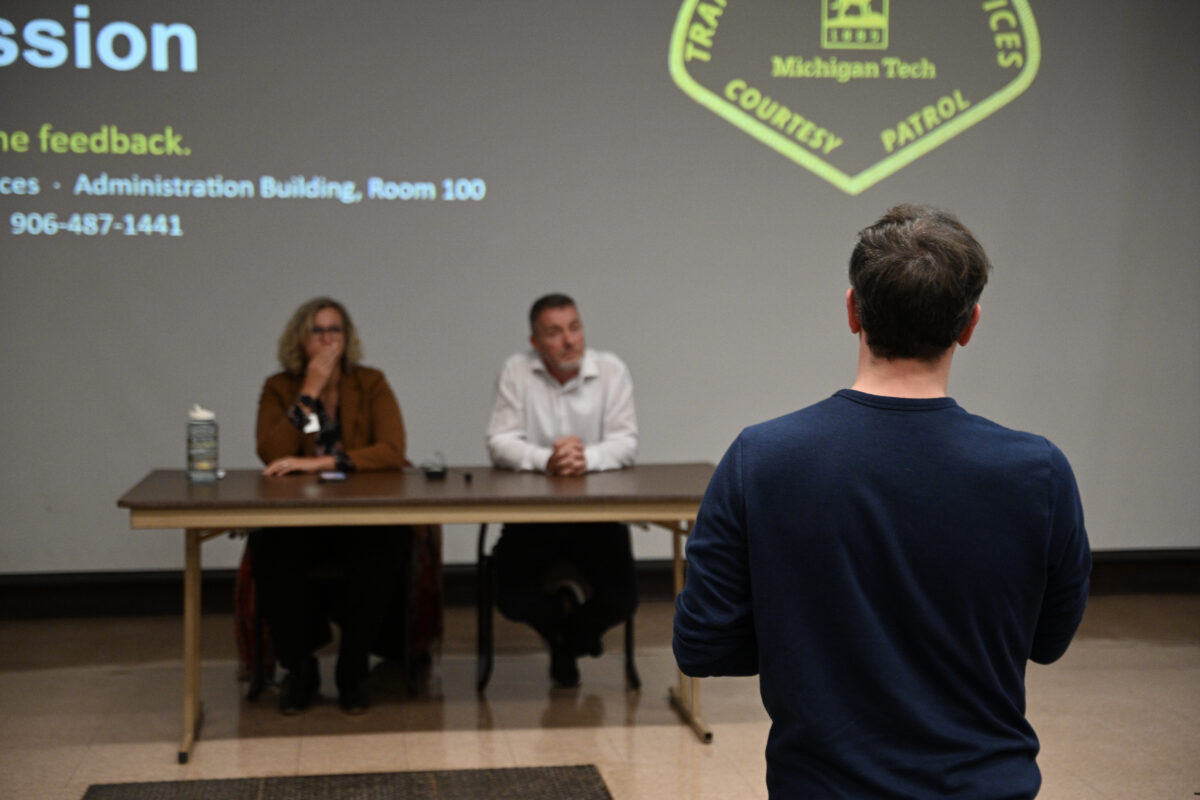
Sean Connors and Kellie Raffaelli present and take questions
Parking changes, shuttle reliability, and winter transportation concerns brought students and university officials together for a town hall meeting on Tuesday, Oct. 27, in Fisher 135. Sean Connors, General Manager of Transportation Services, presented an overview of campus parking and shuttle changes before taking questions from attendees. Dean of Students Kellie Raffaelli addressed concerns, including what students can do when transportation disruptions prevent them from attending class, and provided parking statistics.
During his presentation, Connors explained that parking changes reflected competing demands from residents, commuters, employees, visitors, and campus construction. Connors said guaranteed commuter parking decreased from 107 spaces to 50, while residential parking decreased from 1,845 spaces to 1,820. He acknowledged that graduate students, who had received many of the guaranteed commuter spaces, were particularly affected by the changes.
Changes to several parking lots across campus, notably Lots 24, 26, and 10, have drawn criticism from students. “Most people are wondering why Lot 26 went residential, and 10 went to become commuters … last year we had almost 200 more residential permits than we had space for,” Connors said. Last year, transportation had to assign residential permits in lot 24. This created strain for SDC events, since Lot 24 is used for major events.
Shuttle service was another major topic. Connors explained that service to residential areas, including Daniell Heights, had decreased from twice per hour to once per hour to accommodate direct trips between Lot 24 and the MUB. Many students raised concerns regarding the stop around Daniell Heights and the current shuttle schedules, proposing a combination of stops in Upper Daniell Heights and extending the bus to the SDC to run after 5 p.m.
In an interview with Undergraduate Student Government (USG) Vice President Braden Quesenberry, who helped organize the event, he said, “I don’t expect any immediate changes, but this opens the door to have these conversations between students and administration.” He described the event as an opportunity for students and administrators to better understand one another.
During the question-and-answer session, a student described her experience showing up to her shuttle stop in Hancock at her normal time, only to miss the bus due to a sudden route change which had not been communicated through the TripShot app. Connors explained that snow, unsafe road conditions, and difficulties navigating Hancock streets had forced sudden route changes the previous winter. He apologized for communication problems and said Transportation Services would work to notify riders as quickly as possible.
The student reiterated that the concern was not simply late notice, but that no message appeared to have been sent at all. “Well, if we know ahead of time about the change, there are definitely ways, and if it’s human error, that’s something that we can correct,” Connors said. “If it’s a sudden thing, I can say we’ll do our best.”
Raffaelli said students who miss class because of a verifiable transportation disruption outside their control can contact the Dean of Students office. The office can confirm the circumstances with Transportation Services and send a notice about an excused absence.
Campus construction projects, including East Hall and the planned Chang K. Park Center for Student Wellness, have also affected parking availability by replacing former parking areas. “The largest category that was impacted by that announcement was our Red Faculty/Staff … they’re coming to work every day, and they have to be as close as possible to get to work,” Connors said.
When asked how the town hall went, in a post-meeting interview with the Chair of the events committee for USG, Nolan Dziewit stated it went “about how I expected.” Dziewit explained that there may not be immediate changes or accommodations that can be made. He stated that the meeting was good for “transparency’s sake” and “for them to be able to provide rationale behind their decisions in a public setting.”