Keweenaw Propulsion Lab tests liquid rocket engine
On Sep. 26, Michigan Tech’s most powerful liquid rocket was fired. The rocket was built by the Keweenaw Propulsion Lab (KPL): the largest of five subgroups of the Aeronautics and Rocketry Enterprise (AERE). It was designed for 250 pounds of force at peak for a five-second burn duration.
“What we’re trying to do hasn’t been done by a college student team in the US,” said Walker Schumann, chief engineer of KPL and a graduate Physics student. Their ultimate goal is to launch a liquid rocket up 50 meters in the air – the equivalent height of the MEEM – have it hover for five seconds, and then land. “We’re gonna try to do it by 2030,” said Schumann.
“The static fire of the liquid rocket engine is the first big milestone for us,” says faculty director of the KPL, Dr. Kazuya Tajiri. Dr. Tajiri mentions their next steps are “to be able to control the direction of the thrust, call[ed] gimbling… and second we also need to control the thrust [power].” While the static fire is a good start, they still need systems to control its flight.
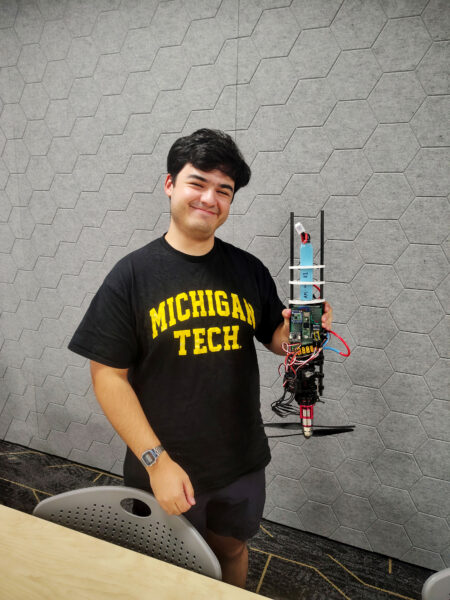
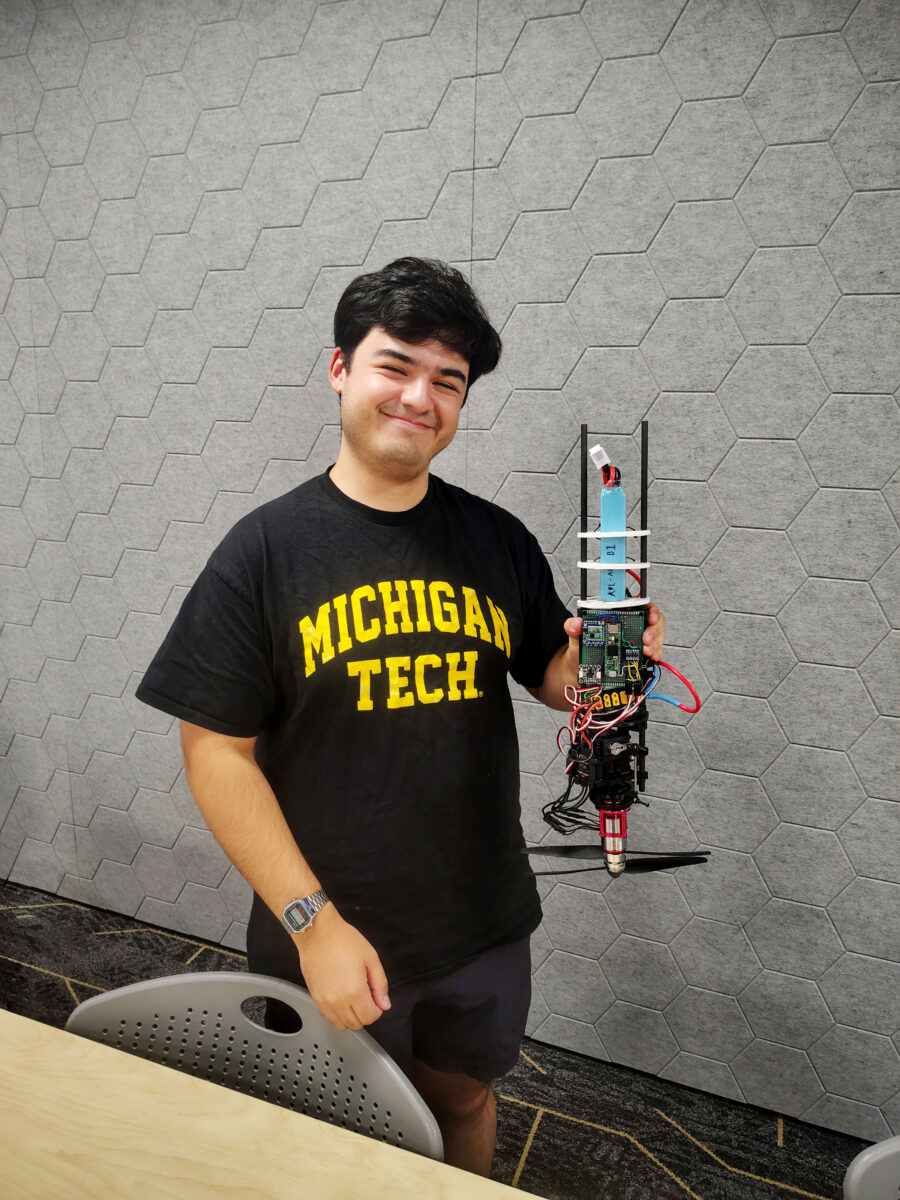
In order to develop these flight algorithms, third-year Computer Engineering major Preston Gump is creating a drone “to test flight controls on something that can crash and not explode; before we test it on something that can explode.” Josh Fernandez, a third-year Computer Engineering major said, “you just have a propeller providing thrust, it’s much easier to interface,” in comparison to a rocket engine. So far Fernandez has “model[ed the rocket]… mathematically in MATLAB and SimuLink.” Their next plan is to implement the control algorithms onto the actual drone.
Since AERE’s inception a year and a half ago, this rocket is their “first deliverable,” said Team Lead for the Throttling Engine Team, Cash Bilton, a fourth-year Mechanical Engineering major. “Up until this point we haven’t had any results,” Bilton said. He added that KPL will continue to develop new engines and test them weekly “until [they’re] ready to fly.”
“We’re entirely student driven and student run,” said Schumann. Operational costs were covered by personal funds, student donations, and the lab fee, where 80 percent of it goes to the member’s sub-enterprise. Their goal is to “10 times our current funding to 25,000 dollars,” Bilton said. Schumann says that KPL credits their early success to Julia Petrin, a 2026 graduate Mechanical Engineering major who “functionally operated as a student advisor,” and was “making her own liquid engines before the enterprise even started.”
For more information, visit their website at aere.enterprise.mtu.edu.